OA-006 / Project
Feb 2026 – Present
FASt Lab Robotic Fish Research
Repaired an inherited MATLAB aeroelastic model and measured real hydrodynamic drag on lab-built robotic fish hardware.
Research on robotic fish systems and fluid-structure interaction, spanning both the numerical model and the hardware that validates it: correcting an inherited MATLAB aeroelastic model that couples Euler–Bernoulli beam FEM with Theodorsen unsteady aerodynamics, rescaling it to tow-tank constraints, and measuring hydrofoil drag, lift, and pitching moment on a load cell in the water tunnel, plus the CAD for the adapter and fin that testing runs on.
Role
Undergraduate research contributor
Organization
University of Florida · FASt Lab
Fixing the aeroelastic model
I inherited a MATLAB aeroelastic model that couples an Euler–Bernoulli beam FEM to Theodorsen unsteady aerodynamics. It would not hold up under refinement: the added-mass and damping terms were formulated incorrectly, so the solution degraded as soon as the mesh was refined past a couple of elements.
Diagnosing and correcting those terms raised the usable mesh resolution 15x, from 2 elements to 30, which is what makes the model trustworthy enough to compare against physical data in the first place.
I then rescaled the model for physical testing, adapting its key design parameters to what the tow tank can actually do: a 1.0 m/s tow speed, a 1-ft carbon-fiber beam, and a NACA 0020 fin.
Measuring drag in the water tunnel
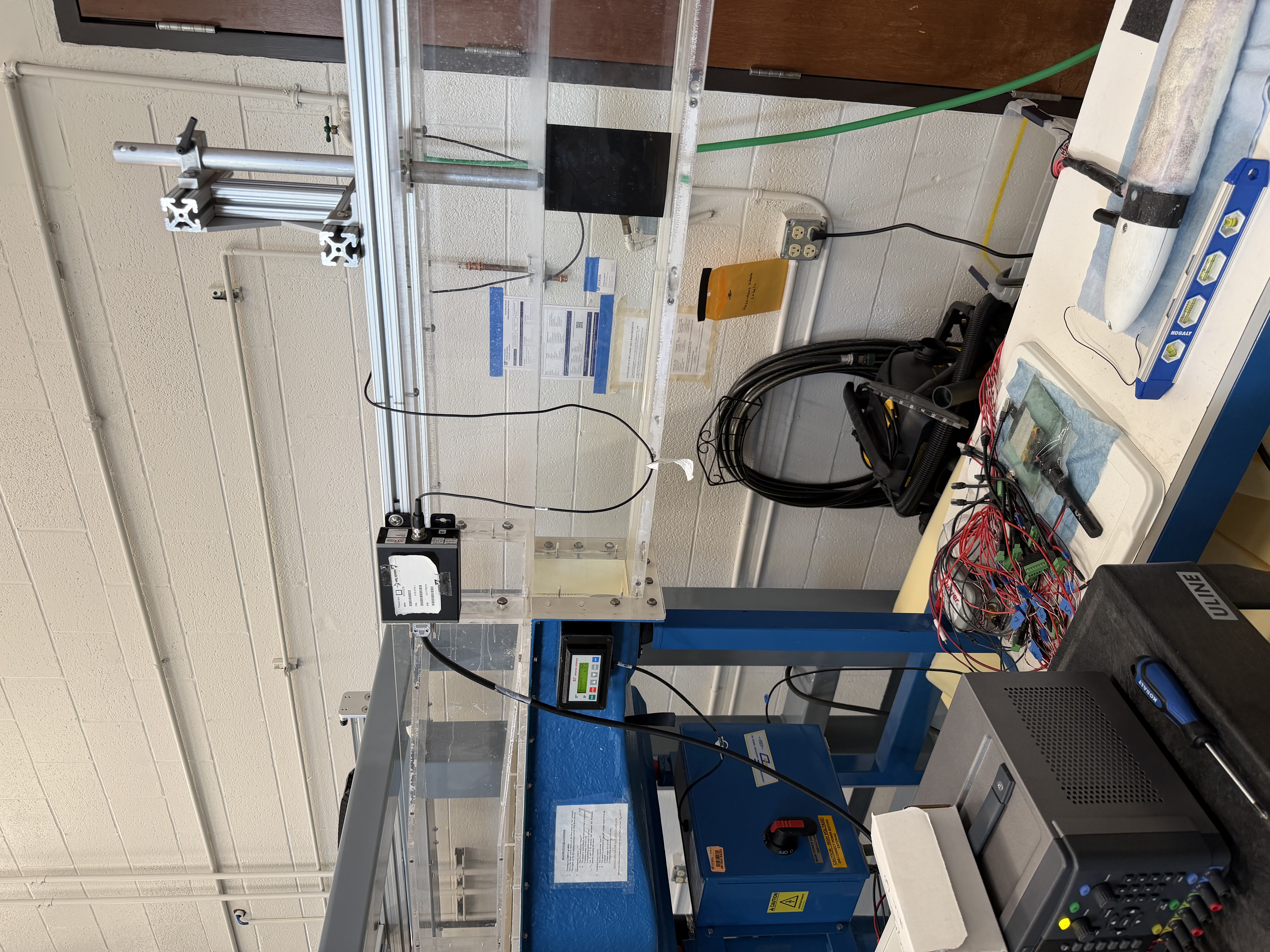
I contributed to research on robotic fish systems and fluid-structure interaction. A big part of that was experimental: mounting a hydrofoil on a load cell in the water tunnel to directly measure drag, with the instrumentation, setup, and data collection done on real hardware.
That work quantifies lift, drag, and pitching moment on a NACA 0012 hydrofoil across −5° to 18° angle of attack and a range of water-tunnel flow speeds, which is the dataset the computational predictions are validated against.
CAD test hardware
To run the experiments I designed the adapter and fin used in the water tunnel, modeling the geometry so the test hardware would mount cleanly and support repeatable drag measurements.